Latest News
All-hands Meeting
The NSF EPSCoR RII Symposium took place on Monday, May 11, 2009 in Baton Rouge, Louisiana. The symposium featured four 'anchor' presentations on CyberTools/Science Driver interactions, a poster competition, an outreach/education session, and plenty of opportunities for networking. Find the Symposium's presentations and posters here.
[Other News]
Research modules are self-contained examples with descriptions of different enabling tools and science applications developed in CyberTools, which can contribute to K-12 or undergraduate classes, as well as outreach to the general public. The aim of this effort is to contribute to the education of the public and young researchers in the fields of computational science and cyberinfrastructure, and to build a sustainable culture in the state towards outreach.
You can click on the image to obtain more information on it, and know more about the projects behind the tutorial.
Cactus Black Hole Interactive Tutorial
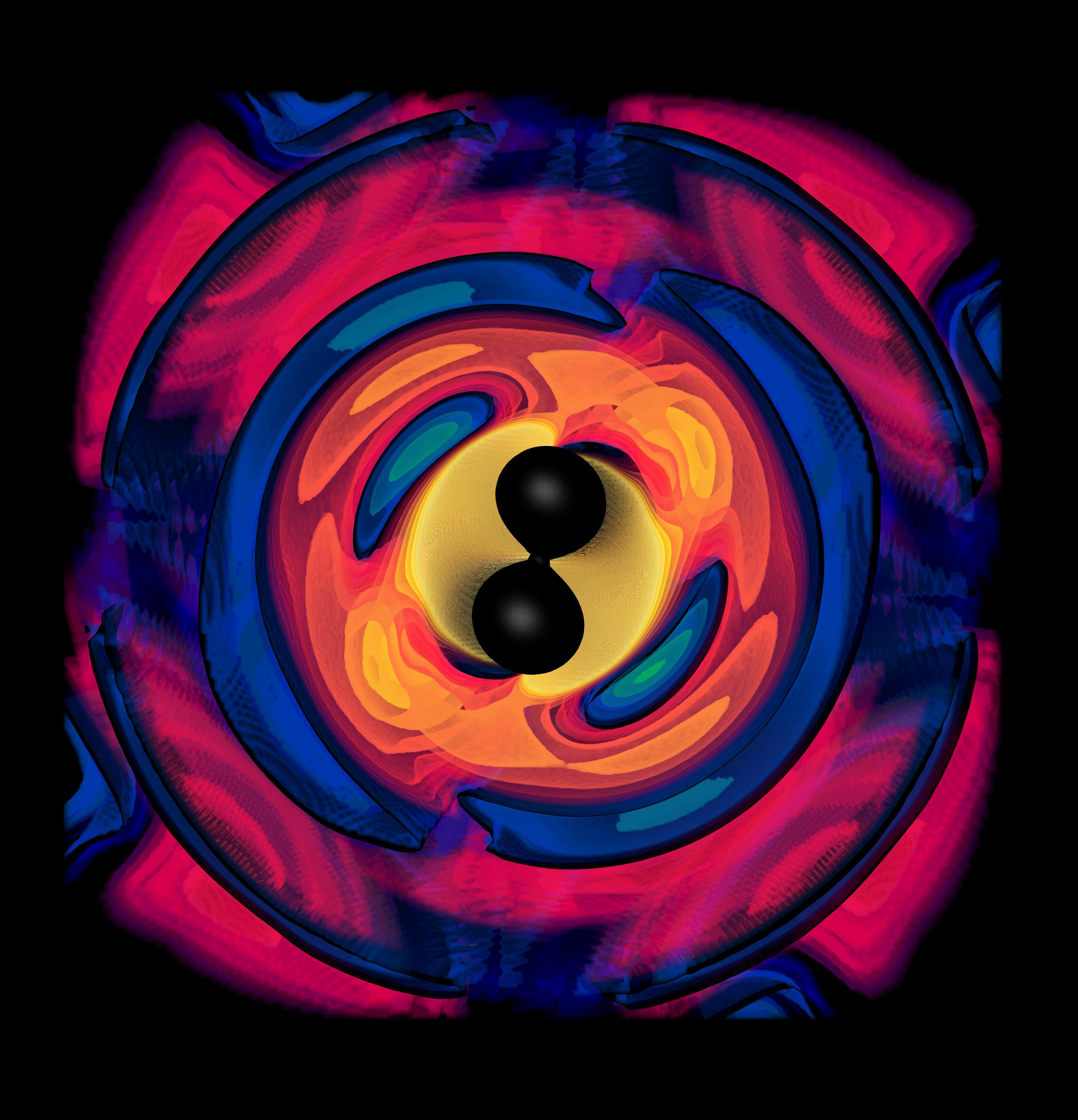 The Cactus Framework provides high level programming abstractions to develop computational science applications that can model physical systems such as black hole collisions or the flow of oil and gas through reservoirs. Cactus applications include tools for remote monitoring and visualization, and can run on the largest supercomputers in the world. This tutorial leads students to explore the features of a running Cactus simulation that is modeling a black hole system, including a web interface to the simulation, basic visualization, performance information and notification to Web 2.0 tools such as Flickr and Twitter. The Cactus Framework provides high level programming abstractions to develop computational science applications that can model physical systems such as black hole collisions or the flow of oil and gas through reservoirs. Cactus applications include tools for remote monitoring and visualization, and can run on the largest supercomputers in the world. This tutorial leads students to explore the features of a running Cactus simulation that is modeling a black hole system, including a web interface to the simulation, basic visualization, performance information and notification to Web 2.0 tools such as Flickr and Twitter.
|
Online Demo: Connect
Tutorial (PDF)
Level: K-12
|
SAGA Tutorial
 The Simple API for Grid Applications (SAGA) provides an application-level programming abstraction for distributed environments. It provides a simple and consistent programmatic interface to the most commonly required Grid functionality. This tutorial provides a quick overview of SAGA and an introduction of some of its elementary capabilities such as multiple-site job-launching and file-transfer. It also shows how to use SAGA to develop simple distributed applications. The Simple API for Grid Applications (SAGA) provides an application-level programming abstraction for distributed environments. It provides a simple and consistent programmatic interface to the most commonly required Grid functionality. This tutorial provides a quick overview of SAGA and an introduction of some of its elementary capabilities such as multiple-site job-launching and file-transfer. It also shows how to use SAGA to develop simple distributed applications.
|
Online Demo: Connect
Tutorial (PDF)
Hands-on exercises
Software
Level: Undegraduate
|
Image Classification Tool Tutorial
 The objective of image classification is to identify images by assigning a class to an image group with homogeneous characteristics on the basis of gray or color level. The tool provides optional user interfaces for users to perform real time classification on regular camera images or on digital mammograms. Users can choose any image already in the database or can provide a new query image for classification. The tool leads students to apply weighted association rules to represent an image and to make image classification and content based image retrieval. The objective of image classification is to identify images by assigning a class to an image group with homogeneous characteristics on the basis of gray or color level. The tool provides optional user interfaces for users to perform real time classification on regular camera images or on digital mammograms. Users can choose any image already in the database or can provide a new query image for classification. The tool leads students to apply weighted association rules to represent an image and to make image classification and content based image retrieval.
|
Online Demo: Connect
Tutorial (PDF)
Hands-on exercises
Software
Level: Undegraduate
|
Protein Data Integration Tool Tutorial
 Proteins are flexible macromolecules that contain backbones which can change from one specific folded conformation to another. Protein folding is frequently guided by local residue interactions that form clusters in the protein core. Evidence indicates that functionally important protein flexible residue interactions are governed by the hydrophobic propensities that they possess. This tool is designed to predict physico-chemical property-flexibility relationships that have been experimentally confirmed as functionally important. This tool leads students to apply graph theory and data mining technologies to extract and isolate protein structural features that sustain invariance in evolutionary related proteins, through the integrated analysis of different hydrophobicity scales over the 3D structure of proteins. Proteins are flexible macromolecules that contain backbones which can change from one specific folded conformation to another. Protein folding is frequently guided by local residue interactions that form clusters in the protein core. Evidence indicates that functionally important protein flexible residue interactions are governed by the hydrophobic propensities that they possess. This tool is designed to predict physico-chemical property-flexibility relationships that have been experimentally confirmed as functionally important. This tool leads students to apply graph theory and data mining technologies to extract and isolate protein structural features that sustain invariance in evolutionary related proteins, through the integrated analysis of different hydrophobicity scales over the 3D structure of proteins.
|
Online Demo: Connect
Tutorial (PDF)
Hands-on exercises
Software
Level: Undegraduate
|
Computational Fluid Dynamics Toolkit Tutorial
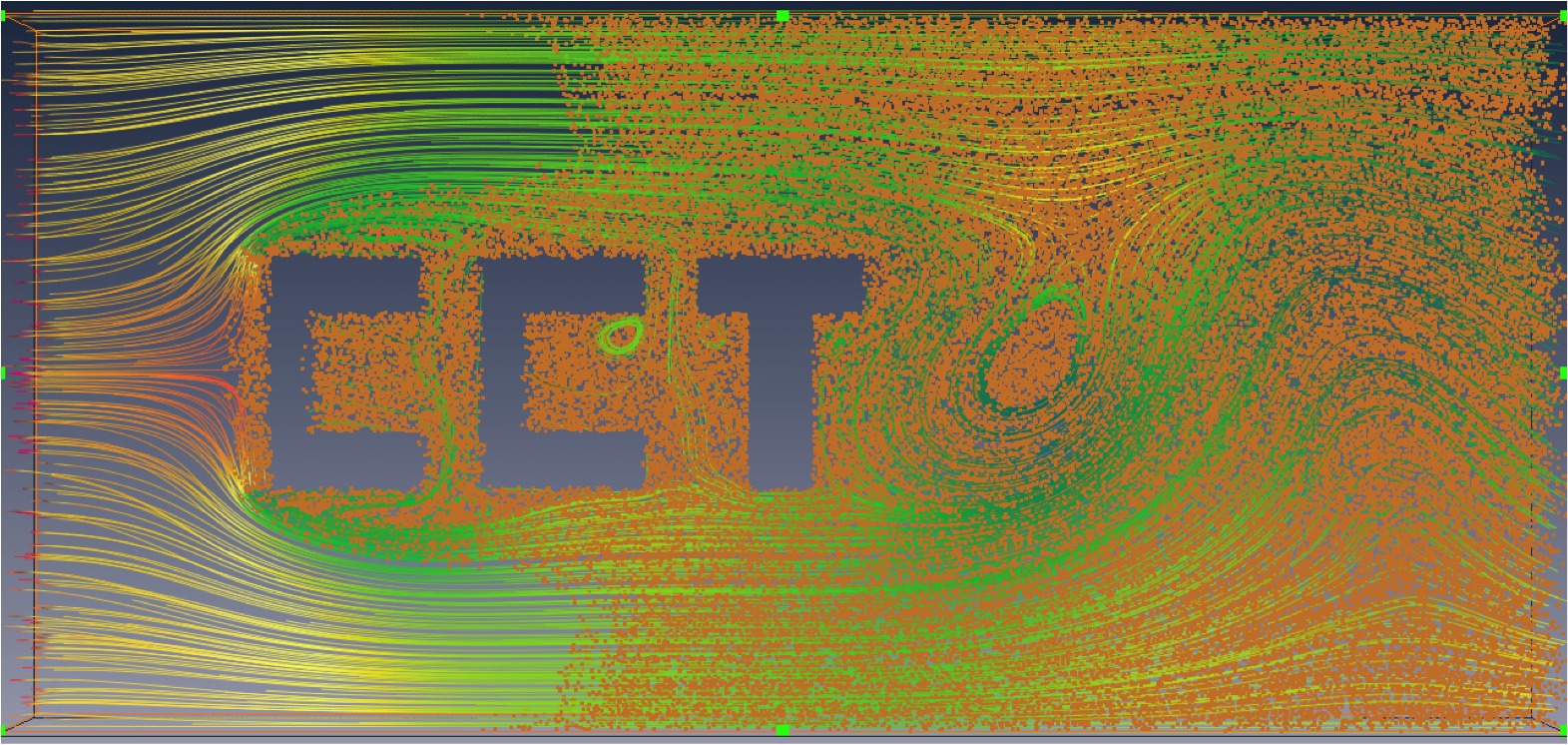 Designing an efficient artificial heart requires understanding the blood flow in human heart just like improving the efficiency of a race car or Boeing 777 requires understanding their aerodynamics. With the advent of high performance computational platforms, computational fluid dynamics approach has made significant advances in the wide areas of engineering and sciences. This tutorial introduces the students with simple fluid dynamics concepts such as drag force and mixing by interactively changing the geometry and placement of obstacles (alphabet letters) in the flow path and visualizing these results. Several other examples such as pollutant dispersion in a model city are also used to explain the importance of such a simulation tool. Designing an efficient artificial heart requires understanding the blood flow in human heart just like improving the efficiency of a race car or Boeing 777 requires understanding their aerodynamics. With the advent of high performance computational platforms, computational fluid dynamics approach has made significant advances in the wide areas of engineering and sciences. This tutorial introduces the students with simple fluid dynamics concepts such as drag force and mixing by interactively changing the geometry and placement of obstacles (alphabet letters) in the flow path and visualizing these results. Several other examples such as pollutant dispersion in a model city are also used to explain the importance of such a simulation tool.
|
Online Demo: Connect
Tutorial (PDF)
Software
Level: K-12
|
Vish Tutorial
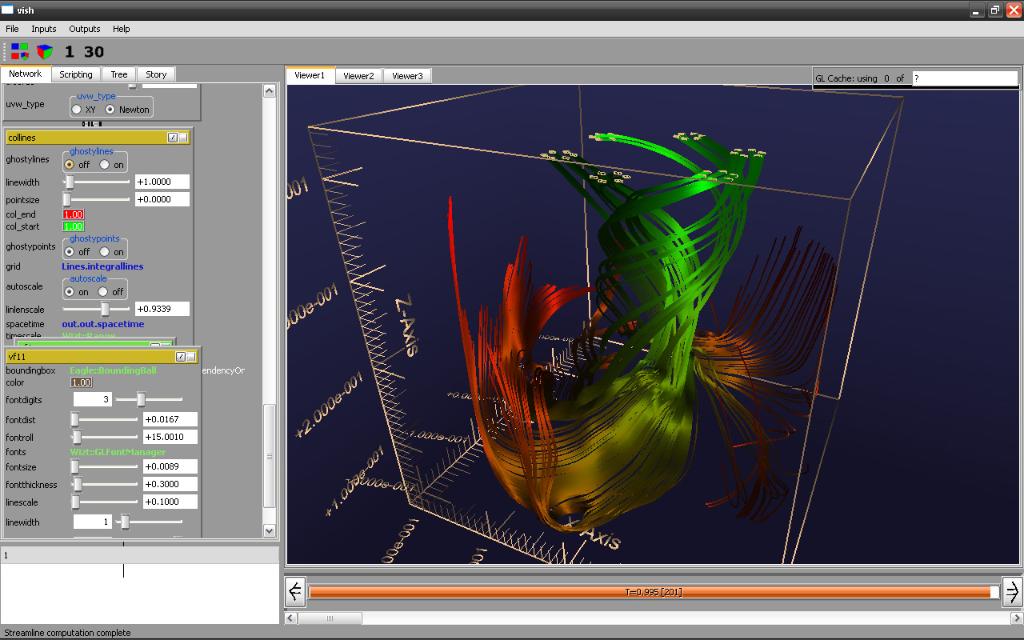 Vish is a software environment for providing newly developed visualization algorithms
in an end-user friendly way. This tutorial introduces the students to Vish using an
ordinary windows machine (decent graphics card is required). Students can download
an self-installer and a huge dataset of a numerical simulation of merging neutron
stars. Starting with a built-in analytic data set, the users will learn how to
apply basic visualization methods, and different ways on how to look at data.
Not only will they be able to inspect a dataset from different view points,
but they will also learn how to apply different analysis methods, and how to
enhance different features of the data. With this basic knowledge they will
be prepared to explore the orbitals of electrons in an atom in different
ways, another intrinsic demo of the Vish visualization shell, and ultimately
be able to also work on the 16GB size data set of the colliding neutron stars
stemming from a real research frontier simulation. Vish is a software environment for providing newly developed visualization algorithms
in an end-user friendly way. This tutorial introduces the students to Vish using an
ordinary windows machine (decent graphics card is required). Students can download
an self-installer and a huge dataset of a numerical simulation of merging neutron
stars. Starting with a built-in analytic data set, the users will learn how to
apply basic visualization methods, and different ways on how to look at data.
Not only will they be able to inspect a dataset from different view points,
but they will also learn how to apply different analysis methods, and how to
enhance different features of the data. With this basic knowledge they will
be prepared to explore the orbitals of electrons in an atom in different
ways, another intrinsic demo of the Vish visualization shell, and ultimately
be able to also work on the 16GB size data set of the colliding neutron stars
stemming from a real research frontier simulation.
|
Online Demo: Connect
Tutorial (PDF)
Software
Level: K-12
|
PetaShare Tutorial
 PetaShare is an NSF sponsored project which responds to the urgent need of scientists who work with large-scale data generation, sharing and collaboration requirements. PetaShare aims to enable domain scientists to focus on their primary research problem, assured that the underlying infrastructure will manage the low-level data handling issues. PetaShare is an NSF sponsored project which responds to the urgent need of scientists who work with large-scale data generation, sharing and collaboration requirements. PetaShare aims to enable domain scientists to focus on their primary research problem, assured that the underlying infrastructure will manage the low-level data handling issues.
|
Online Demo: Connect
Tutorial (PDF)
Software
Level: Undergraduate
|
Viz-Tangibles
Video recording of a variation of http://csc.lsu.edu/~ullmer/talks/bor-tangible-science-ligo.2009-08/ targeted at K-12 student and teacher audience; Including video recording of current kiosk, video recording of tangibles interaction with stir tanks, talk about underlying technology and design; and talk about the future of each of these (including upcoming K-12 deployments). Will include a URL to which people could follow up with (a) general questions; or (b) specific interests in having the kiosk come to their school, etc.
|
Online Demo: Connect
Tutorial (PDF)
Software
Level: K-12
|
CyberTools Student Videos
Graduate and undergraduate students talk about their role in CyberTools. These 3 min. soundbites are an overview of their research experience while participating in CyberTools.
|
Links:
Level: K-12
|
Basic Programming Tutorial
CCT’s Steve Brandt provides a step-by-step introduction to programming languages such as Perl, Java, Haskell, Python, and MPI. http://stevenrbrandt.com/cios/
|
Links:
Level: K-12, Undergraduate
|